Parakeet-TDT-0.6B-v2 is a 600-million-parameter automatic speech recognition model designed for high-quality English transcription. Despite its relatively modest size compared to multi-billion parameter alternatives, this model delivers exceptional performance across a wide range of benchmarks.
The name “Parakeet” represents NVIDIA’s family of ASR models, while “TDT” refers to the innovative Token-and-Duration Transducer architecture that powers it. The “0.6B” indicates its parameter count (600 million), and “v2” signifies this is an improved second version of the model.
Key features of Parakeet-TDT-0.6B-v2 include:
Key features and capabilities
Parakeet-TDT-0.6B-V2 is a 600-million-parameter ASR model designed specifically for high-quality English transcription. The model offers several standout features:
The model is based on NVIDIA’s FastConformer architecture with the Token Duration Transducer (TDT) decoder, combining cutting-edge design elements to achieve state-of-the-art results.
Model architecture: FastConformer meets TDT
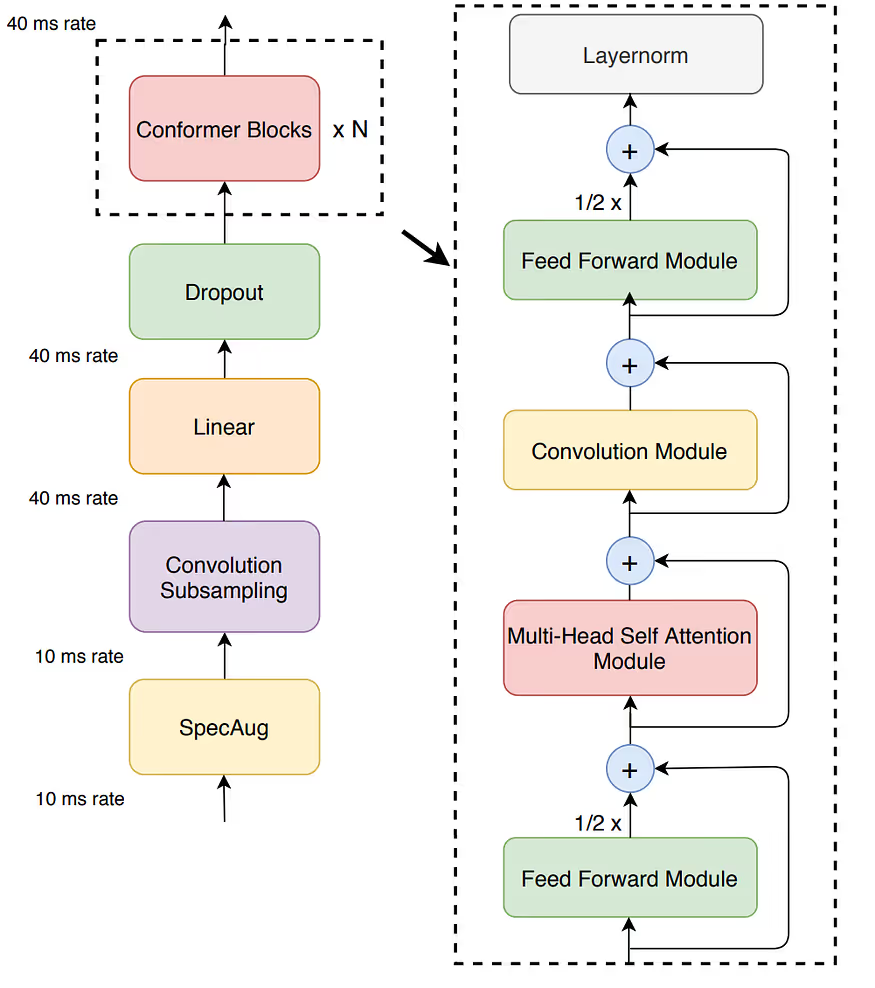
FastConformer: Optimised encoder architecture
The Parakeet-TDT-0.6B-v2 model is built on the FastConformer encoder architecture, a highly optimised version of the standard Conformer model that has dominated speech recognition tasks in recent years. FastConformer introduces several key innovations that significantly enhance performance:
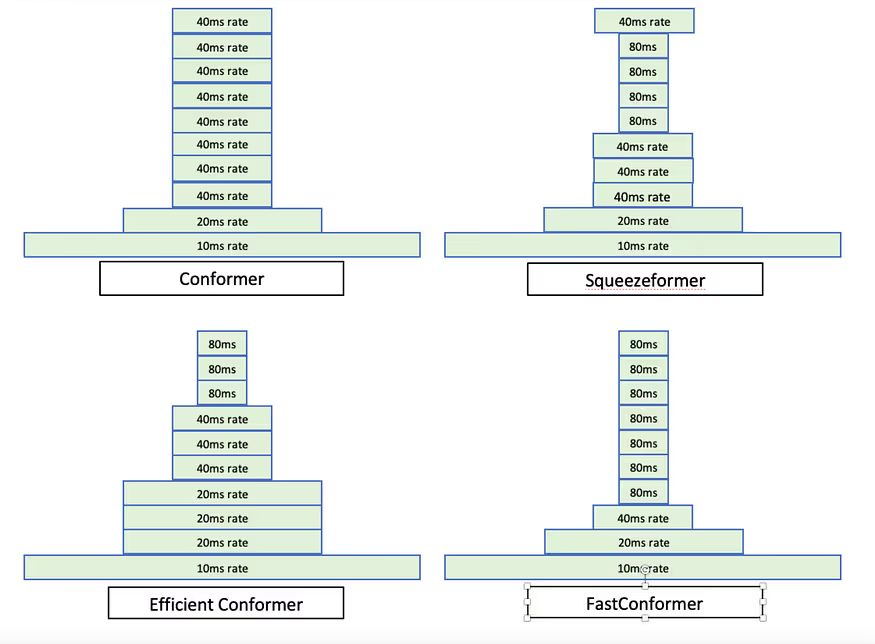
These modifications result in an encoder that is approximately 2.4–2.8 times faster than the regular Conformer encoder without significant quality degradation. Additionally, FastConformer supports efficient processing of long audio sequences through a linearly scalable attention mechanism inspired by the Longformer approach, which combines local attention with global tokens to maintain performance while reducing computational overhead.
Token Duration Transducer (TDT): The secret weapon
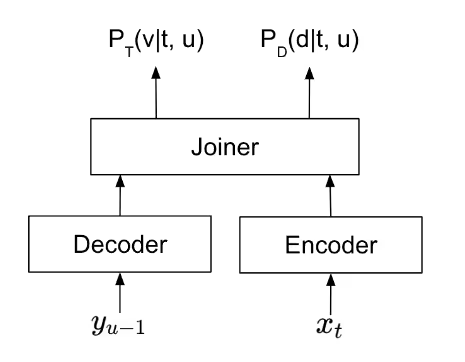
A key innovation in the Parakeet-TDT-0.6B-V2 model is the Token Duration Transducer (TDT) decoder, which extends conventional RNN-Transducer architectures by jointly predicting:
This dual prediction system uses a joint network with two independently normalised outputs that generate distributions for tokens and their durations. During inference, the TDT can skip input frames based on predicted durations, making it significantly faster than conventional Transducers that process encoder output frame by frame.
The TDT approach offers several critical advantages:
Performance benchmarks: setting new standards
The Parakeet-TDT-0.6B-V2 model demonstrates impressive performance across a variety of benchmarks, making it a top contender in the ASR space.
Word Error Rate (WER) performance
The model achieves remarkable accuracy across multiple datasets, as shown in the following table:
Dataset-specific WER scores include:
Noise robustness
Parakeet-TDT-0.6B-v2 maintains strong performance even in noisy environments:
This robust performance across varying noise levels makes the model suitable for real-world applications where perfect acoustic conditions cannot be guaranteed.
Processing speed
One of the most remarkable aspects of Parakeet-TDT-0.6B-v2 is its processing speed. The model demonstrates an impressive real-time factor (RTF) of 3380 with a batch size of 128, meaning it can transcribe approximately 56 minutes of audio in just one second under optimal conditions.
Even with smaller batch sizes or on less powerful hardware, the model maintains strong performance, making it suitable for both real-time applications and batch processing scenarios.
Comparison with competitor models
When comparing Parakeet-TDT-0.6B-V2 with other state-of-the-art ASR models, several key advantages become apparent:
vs. OpenAI’s Whisper model
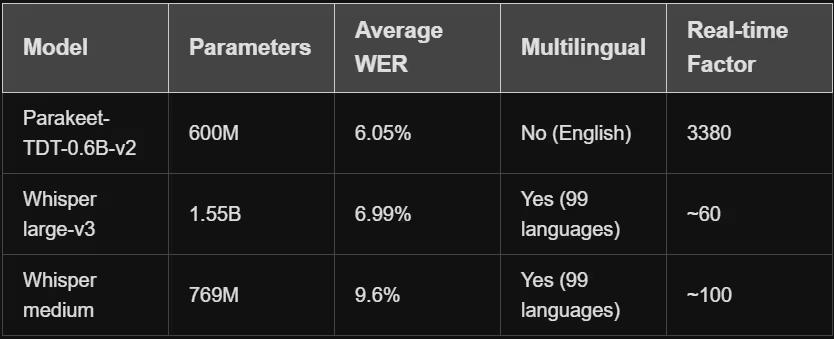
vs. Meta’s MMS and wav2vec 2.0
vs. Other NVIDIA ASR models
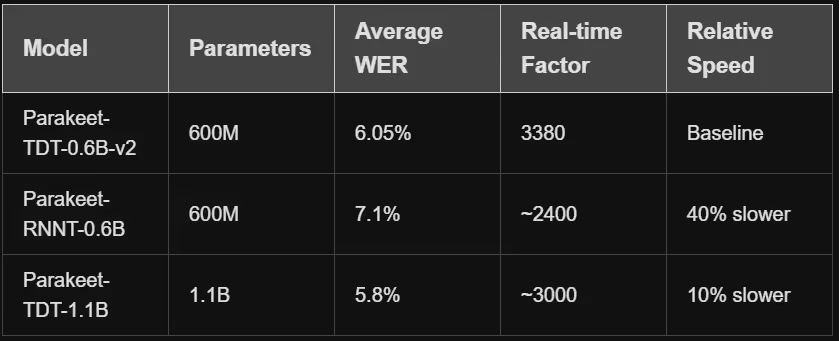
Other commercial solutions
When compared to commercial ASR solutions like Google Speech-to-Text, Amazon Transcribe, and Microsoft Azure Speech, Parakeet-TDT-0.6B-v2 offers several advantages:
However, commercial solutions may offer additional features like speaker diarization, enhanced multilingual support, or tighter integration with their respective cloud ecosystems.
How to use Parakeet-TDT-0.6B-V2
The model is available through NVIDIA’s NeMo toolkit and can be easily integrated into applications for inference or fine-tuning. Here’s a simple guide to get started:
Installation and setup
First, you’ll need to install the NeMo toolkit and its ASR components:
Basic transcription
To transcribe an audio file, you can use the following Python code:
Transcription with timestamps
If you need timestamp information along with the transcription:
Building a web UI with Gradio
You can also create a simple web interface for transcription using Gradio:
Setting Up a local environment
For those who want to run the model locally, here are the key requirements:
Minimum hardware requirements
Recommended hardware
Step-by-step installation (Ubuntu/Linux)
Install Python and dependencies:
Install NeMo toolkit with ASR support:
Test the installation with a basic transcription:
Technical deep dive: training details
The Parakeet-TDT-0.6B-V2 model was trained using a sophisticated approach to achieve its high performance:
Training process
Training dataset
The model was trained on the Granary dataset, comprising approximately 120,000 hours of English speech data:
This diverse dataset ensures robust performance across various domains, accents, and recording conditions.
Best practices and optimisation tips
To get the most out of Parakeet-TDT-0.6B-v2, consider these optimisation strategies:
2. Long audio handling:
Applications and use cases
The exceptional performance and efficiency of Parakeet-TDT-0.6B-v2 make it suitable for a wide range of applications:
Content creation and media
Business and enterprise
Accessibility
Research and development
Limitations and considerations
While Parakeet-TDT-0.6B-v2 offers impressive capabilities, it’s important to be aware of its limitations:
3. GPU dependency: The model is optimized for NVIDIA GPUs and requires appropriate hardware for optimal performance.
Future directions
The innovations demonstrated in Parakeet-TDT-0.6B-v2 point to several exciting future directions for speech recognition technology:
Hugging face space: try the space here
Conclusion
NVIDIA’s Parakeet-TDT-0.6B-v2 sets a new standard in speech recognition by proving that smart architecture can outperform sheer model size. With its FastConformer encoder and Token-and-Duration Transducer decoder, it delivers exceptional accuracy, speed, and efficiency-all in a compact 600-million-parameter model.
For teams building real-world applications, it offers the best of both worlds: cutting-edge transcription quality and practical deployment, without the heavy hardware demands of larger models. Backed by the open-source NeMo toolkit, it’s easy to integrate, fine-tune, and scale across use cases ranging from media and accessibility to research and enterprise tools.
As the field moves forward, Parakeet-TDT-0.6B-v2 illustrates the future of speech recognition: purpose-built models that prioritize performance, precision, and usability over size alone.
References
By combining the efficiency of the FastConformer architecture with the speed and accuracy benefits of the Token Duration Transducer, NVIDIA has created a truly exceptional ASR model that sets new standards for the industry while remaining accessible and practical for real-world applications.
For reference you can visit this : https://medium.com/@akshaychame2/nvidia-parakeet-tdt-0-6b-v2-a-deep-dive-into-state-of-the-art-speech-recognition-architecture-d1f0b8e61e4b