Autonomous AI agents are taking centre stage in 2025. No longer limited to basic automation or scripted interactions, these agents now operate independently, make decisions, and handle complex workflows across diverse domains. Among the frontrunners in this shift is Genspark Super Agent—an AI assistant designed to perform high-level tasks with minimal human input, combining reasoning, execution, and adaptability in one system.
This blog unpacks the architecture and features that power Genspark, examines how it’s being used in the real world, and provides a side-by-side comparison with Manus AI, another well-known autonomous agent. As AI continues to expand its role across industries, understanding what separates these agents—and where they fit into practical business and individual workflows—is more relevant than ever.
What is Genspark super agent?
Genspark Super Agent, developed by Palo Alto-based startup MainFunc and released in early 2025, marks a major advancement in autonomous AI technology. Built to think, plan, act, and use tools independently, it handles complex, real-world tasks with minimal user input.
What sets Genspark apart from traditional AI assistants is its ability to go beyond basic commands. Instead of simply responding to prompts, it orchestrates multi-step workflows—drawing from multiple data sources, using external tools, and adapting its actions based on evolving needs.
Whether it’s planning an international trip, conducting in-depth market research, or producing multimedia content, Genspark functions more like an intelligent executive assistant than a chatbot. It not only executes tasks but also provides clear visibility into how and why it makes decisions—bringing transparency to every action it takes.
The technical architecture behind Genspark super agent
At the core of Genspark’s capabilities lies its innovative “Mixture-of-Agents” architecture, which distinguishes it from many other AI systems in the market.

Mixture-of-agents design
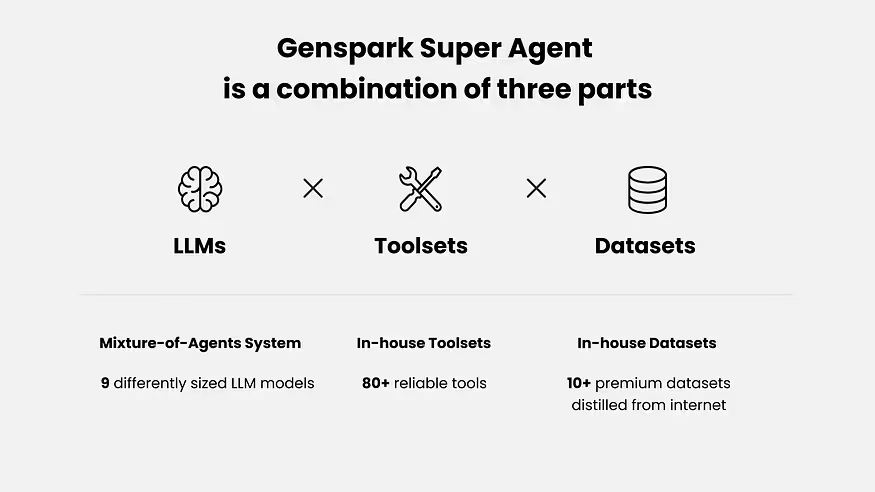
Genspark Super Agent integrates nine distinct large language models (LLMs), over 80 in-house tools, and more than ten curated datasets MarkTechPost1. This design enables the system to intelligently route each task to the optimal model based on complexity, speed, and accuracy requirements.
The architecture allows Genspark to:
This architectural approach has enabled Genspark to achieve impressive benchmark results, scoring 87.8% on the GAIA benchmark, which evaluates AI agents on real-world task automation VentureBeat2.
Key features of Genspark super agent
Genspark Super Agent offers a comprehensive suite of features designed to handle diverse tasks across multiple domains:

1. Autonomous task planning and execution
The system can efficiently plan and execute multi-step tasks with minimal supervision. It breaks down complex requests into manageable steps, selects appropriate tools, and executes each step in sequence, maintaining context throughout the process.
2. Real-time voice automation
One of Genspark’s most distinctive features is its ability to perform actual phone calls using AI-generated voices. This enables real-world interactions like restaurant reservations, appointment scheduling, or information inquiries MarkTechPost1.
3. Dynamic content generation
Genspark excels at creating high-quality multimedia content, including:
This capability allows for the rapid production of professional and engaging content with minimal user input Medium3.
4. Live data integration and research
The agent can conduct comprehensive research by gathering, analyzing, and synthesizing information from multiple online and internal sources. It produces accurate, citation-rich research reports valuable for market analyses, competitive research, and academic purposes MarkTechPost1.
5. User-friendly interface
Genspark offers an intuitive, conversation-based interface that requires no technical setup. Users can begin experimenting with the platform immediately without providing personal credentials, making it accessible to users of varying technical expertise VentureBeat2.
6. Generous free tier
Unlike many competitors, Genspark offers a free tier with 200 daily credits, making it highly accessible for individuals and small businesses wanting to explore AI agent capabilities MarkTechPost1.
Real-world applications of Genspark super agent
Genspark Super Agent’s versatility makes it applicable across numerous use cases:
Automated trip planning
The system can plan comprehensive trips by gathering real-time data on accommodations, weather, attractions, and events. For example, a simple command like “Plan a weekend trip to San Diego” results in a complete itinerary with hotel recommendations, activity suggestions, and even restaurant reservations through its voice-calling feature MarkTechPost1.
In a demonstration, Genspark’s agent planned a five-day San Diego trip, calculated walking distances between attractions, mapped public transit options, and used voice-calling to book restaurants while accounting for food allergies and seating preferences VentureBeat2.
Creative content production
Genspark can create sophisticated multimedia content autonomously. It has demonstrated the ability to:
These capabilities significantly reduce the time and resources needed for content creation VentureBeat2.
Market research and analysis
The agent excels at gathering and synthesizing information for market research and competitive analysis. It can research industry trends, identify key players, analyze growth areas, and compile comprehensive reports with proper citations Medium4.
Data analysis and visualization
Genspark can process large datasets, identify patterns and trends, and create interactive visualizations to help users understand complex information intuitively.

Introducing Manus AI: a Leading competitor
To understand Genspark Super Agent’s position in the market, it’s essential to compare it with one of its primary competitors, Manus AI.
Manus AI, developed by Chinese startup Monica and launched in early 2025, quickly gained recognition for its strong performance across a wide range of autonomous tasks. Designed to operate with minimal oversight, Manus AI can independently execute complex, multi-domain workflows—making it a serious contender in the autonomous agent space.
Its integration with platforms like Hugging Face has further extended its capabilities, allowing it to tap into powerful open-source models and tools. From automating research processes to managing business operations, Manus AI is positioned as a versatile and capable system for both enterprise and individual use.
Key features of Manus AI
Manus AI offers several powerful capabilities:

The technical architecture of Manus AI
Manus AI utilizes a multi-agent architecture where various specialized sub-agents work together. It primarily integrates two large language models, including Anthropic’s Claude, and supplements these with specialized tools and capabilities of AI Fire6.
Genspark Super Agent vs. Manus AI
Task performance comparison
Conclusion
The rise of autonomous AI agents like Genspark Super Agent and Manus AI reflects a broader shift in how businesses and platforms approach complex task execution. In 2025, AI agents are no longer experiments—they’re becoming operational. According to industry data, the global AI agent market is projected to hit $7.63 billion this year, with a 45.8% growth rate, driven by demand for task automation and smart decision systems. Major enterprises like Deloitte have already seen over 75% of their UK audit staff adopt internal AI agents for summarizing content, writing code, and performing research.
This trend extends into platforms like Drupal, where AI is moving beyond simple enhancements to become part of the core content workflow. Modules like OpenAI and Augmentor are actively being used to generate content, rewrite copy, and automate image creation. Discussions from DrupalCon Atlanta 2025 make it clear: AI isn’t just an add-on—it’s shaping the future of editorial and publishing systems.
Genspark and Manus represent two paths in this shift: accessible, real-world interaction vs. developer-grade autonomy. But both are part of the same direction—toward agents that don't just assist, but fully handle planning, creation, analysis, and execution. And as Drupal and other systems become agent-ready, we’re entering a phase where much of our work—whether technical, creative, or operational—starts with a single command to an AI agent.
https://www.youtube.com/live/NvsIsDv5UzY
https://www.youtube.com/live/IilRuxCr3Ho
https://www.youtube.com/live/XIlP6oYTs8w