MiniMax-01, created by MiniMax AI, is an important development in the area of large language models (LLMs), especially when you talk about long-context processing and multimodal AI functionality.
MiniMax-01 in Series 2 introduces an advanced methodology for natural language understanding and generation, designed for applications spanning content creation, research support, and business automation
This model has two specialised versions, each of which is optimised to perform well in particular areas:
It is designed to capture and process deep contextual information and is particularly geared for applications such as document summarization, conversational AI, and intricate reasoning.
The version that takes MiniMax AI beyond text processing to include understanding images, generating captions, and text-vision integration for interactive AI experiences.
Architecture highlights
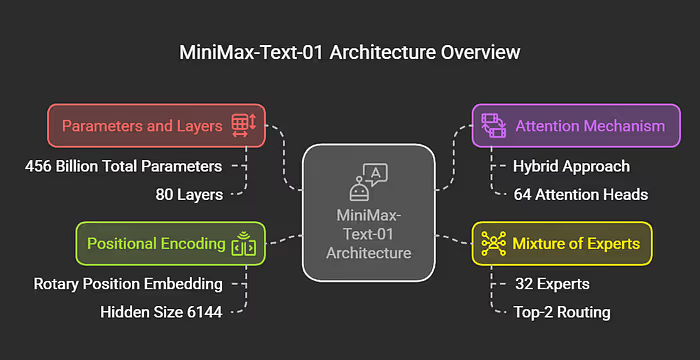
MiniMax-Text-01 is built for efficiency and scalability, featuring 456 billion total parameters with 45.9 billion activated per token to balance computational power. Its 80-layer structure enables deep learning capabilities, capturing complex patterns effectively.
The hybrid attention mechanism combines lightning attention for efficiency with softmax attention every 7 layers for precision, supported by 64 attention heads with a dimension of 128.
The Mixture of Experts (MoE) architecture includes 32 experts with a hidden size of 9216, using a Top-2 routing strategy to enhance specialization while reducing computational overhead.
Rotary Position Embedding (RoPE) ensures accurate positional encoding, applied to half of the attention head dimension with a base frequency of 10,000,000, helping maintain long-range context. With a hidden size of 6144 and a vocabulary of 200,064 tokens, MiniMax-Text-01 is optimized for processing diverse and extended inputs efficiently.

Core text benchmark performance
MiniMax-Text-01 demonstrates strong capabilities across various natural language processing tasks, as reflected in multiple benchmark evaluations:
1. MMLU and MMLU-Pro
2. C-SimpleQA and IFEval
3. GPQA and MATH
4. Humaneval
Long-context RULER performance
Context Length Handling
Comparative analysis
Competitive edge
Model specifications and key features
MiniMax-Text-01 is engineered for efficiency and scalability, with the following core specifications:
Performance and contextual capabilities
Research suggests that MiniMax-Text-01 excels in long-context processing, with a training context length extending to 1 million tokens and the ability to handle up to 4 million tokens during inference.
This capability is significantly larger than many contemporary models, such as Google’s Gemini 1.5 Pro with a 2-million-token context window, positioning MiniMax-Text-01 as a leader in this aspect.
The evidence leans toward matching the performance of top-tier models on various benchmarks, with the least performance degradation as input length increases, as highlighted in related blog posts.

Architectural diagrams and visual representation
For a visual understanding, the architecture of MiniMax-Text-01 is detailed in Figure 3 of the research paper MiniMax-01 Report, which illustrates a Transformer-style block with channel mixers (lightning and softmax attention) and a feature mixer (MoE with multiple FFNs).
Additionally, Figure 5 in the same paper compares computations for softmax and linear attention, showing input length NNN and feature dimension ddd, with d≪Nd \ll Nd≪N, and linear attention achieving O(N) time and space complexity. These diagrams provide insight into the structural design and efficiency optimizations.

Comparative analysis with related models
While the focus is on MiniMax-Text-01, it’s worth noting the context of MiniMax-VL-01, which uses the “ViT-MLP-LLM” framework, initialized with a 303-million-parameter Vision Transformer (ViT) for visual encoding, a two-layer MLP projector for image adaptation, and MiniMax-Text-01 as the base LLM.
This multimodal extension highlights the versatility of the underlying architecture, with dynamic resolution features for input images resized from 336×336 to 2016×2016, maintaining a 336×336 thumbnail.
Resource availability and accessibility
The model is likely open-source, with access facilitated through several platforms:
The research paper MiniMax-01 Report serves as a comprehensive resource, detailing the architecture, training, and inference optimizations, including advanced parallel strategies like Linear Attention Sequence Parallelism Plus (LASP+), varlen ring attention, and Expert Tensor Parallel (ETP).

MiniMax-Text-01 employs a Transformer-style architecture optimized for long-context processing and efficient computation. It integrates a Mixture of Experts (MoE) approach with linear attention to reduce resource consumption while maintaining high performance.
The model alternates 7 layers of linear attention with 1 softmax attention layer, totalling 80 layers. It features 64 attention heads (128 dimensions each), Rotary Position Embedding (RoPE) for positional encoding, and Group Query Attention (GQA) for optimized query handling. With 456 billion parameters (45.9 billion activated per token), it balances efficiency and scalability.
A novel global router ensures stable MoE load balancing, while DeepNorm enhances performance.
Summary of architectural details
To organize the information, here is a detailed table summarizing the key attributes of MiniMax-Text-01:

Usecases :
1) According to the illustration, which planet has the most satellites? Which one has the most large satellites? Please specify the numbers separately. Also, do only planets have satellites?

Checklist :
Output :
According to the illustration, the planet with the most satellites is Saturn, which has 9 satellites: Mimas, Enceladus, Tethys, Dione, Rhea, Titan, Hyperion, Iapetus, and Phoebe. The planet with the most large satellites is Jupiter, which has 4 large satellites: Io, Europa, Ganymede, and Callisto. Not only planets have satellites. In the illustration, we can see that besides planets, there are other celestial bodies that also have satellites.
For example, the dwarf planet Pluto has one satellite: Charon; the dwarf planet Eris has one satellite: Dysnomia; even the asteroid Ida has one satellite: Dactyl. In summary, the planet with the most satellites is Saturn, the planet with the most large satellites is Jupiter, and celestial bodies with satellites are not limited to planets, but also include dwarf planets and asteroids.
2) How many of the outfits in each row in the picture are matched with long skirts?

Checklist:
Output :
First row:
Second row:
Third row:
1. The first set: long skirts
3. The third set: trousers
4. Fourth set: trousers
5. The fifth set: trousers
2. Second set: trousers
6. Sixth set: trousers There is a total of 1 set in the third row with a long skirt.
To sum up, there are 3 sets, 2 sets, and 1 sets of long skirts in each row.
3) Based on the provided flowchart and statistical data, determine which step takes the longest and how to optimize it?

Checklist:
Output:
According to the provided flowchart and statistics, the longest step is "Enter invoice details," with an average time of 53.6 seconds. To optimize this step, we can take the following measures:
By implementing the above methods, we can significantly reduce the time spent on the "Enter invoice details" step, improving the overall efficiency of the process and user satisfaction.
Bringing AI home: the power of flexible deployment
Want to set up an AI that understands the unique language of your industry? Or create a chatbot that speaks directly to your customers' needs? MiniMax-01 makes it possible.
Think of it like having a super-smart colleague who can be customized to fit perfectly into your team. Whether you're running a local GPU setup in your office or leveraging cloud infrastructure, this AI adapts.
The future is collaborative: AI that grows with you
MiniMax-01 redefines what AI can do. Imagine an AI that not only processes words but truly understands context. It serves as a research assistant, translator, and creative partner—all in one. Its strength lies in handling complex information, seamlessly connecting text and visual understanding in a way that feels intuitive.
What makes this technology so compelling is its openness and flexibility. Developers and researchers have the freedom to enhance and expand MiniMax-01’s capabilities, unlocking new possibilities.
This AI goes beyond solving problems—it helps reshape how we think about them. From building more intuitive chatbots to enabling AI-driven, multi-step reasoning, it feels less like a tool and more like a true collaborator.
As AI advances, MiniMax-01 marks a significant step forward—a vision of a future where intelligence adapts, understands, and aligns seamlessly with human creativity and complexity.
Resources and further reading
For those interested in exploring more, the model is likely open-source, with access points including the GitHub repository MiniMax-01 and the HuggingFace model page MiniMax-Text-01. Detailed architecture diagrams, such as Figure 3, can be found in the research paper MiniMax-01 Report. You can also try it online at Hailuo AI or visit the homepage of MiniMax AI for more information.
Key Citations