Slowdowns happen across teams. Editors rewrite content. Developers repeat code. Marketers wait on creatives. What if your Drupal site could take on some of that work?
Drupal AI gives you that option. It adds tools inside the CMS so teams can draft, review, generate, and automate without leaving Drupal. You can connect to providers like OpenAI, Anthropic, or Google Gemini, or run open-source models on your own.
This blog walks through how Drupal AI works, the modules it offers, and how teams who build, write, review, or manage can start using it right away.
What is the Drupal AI Framework?
Drupal AI is more than a module; it’s a complete framework for adding AI capabilities to your Drupal site. It simplifies how you connect with different AI services, making it easy to use providers like OpenAI (ChatGPT, DALL·E), Anthropic (Claude), Google Gemini, and Hugging Face.
It also works well with open-source models hosted on platforms like Ollama, LMStudio, and Hugging Face, giving teams flexibility and control over where and how their data is processed.
Why should you care?
Key Features of Drupal AI Modules
Let’s get deeper into what makes the Drupal AI framework so versatile and powerful:
1. Unified framework for multiple AI providers
The core strength of the Drupal AI framework lies in its abstraction layer. This enables seamless integration with third-party AI providers such as:
Additionally, you can host open-source models using platforms like Ollama, LMStudio, and Huggingface, giving you full control over data privacy and security.
2. Submodules tailored to your needs
The Drupal AI framework includes submodules designed for various roles and needs:
AI core
This acts as the foundation, allowing modules to swap out any model they need. It ensures flexibility and scalability for future-proof solutions.
AI explorer
An admin interface where you can experiment with text generation prompts. Perfect for testing ideas before implementing them on your live site.


AI automators
Automate tasks like populating fields, scraping websites, extracting text from files, and chaining workflows. These automators are ideal for creating dynamic AI-powered applications.

AI search
Transform traditional search functionality with semantic search powered by AI. Use Retrieval Augmented Generation (RAG) techniques to provide context-aware results directly from your content database.

AI assistants API + chatbot
Configure chatbots tailored to your needs. Integrate these bots into your site to answer queries, guide users, or perform searches intelligently.
AI CKEditor

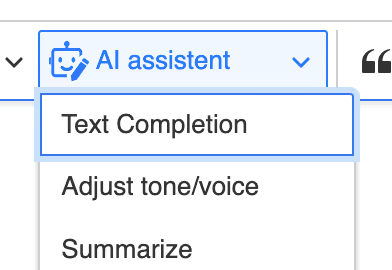
Add an AI assistant within CKEditor 5 for spell checks, translations, tone adjustments, and summarizations—all at the click of a button.
AI content
Streamline content creation with features like tone adjustment, taxonomy suggestions, moderation checks, and automatic alt-text generation for images.

AI validations
Works with field_validations so you can use AI/LLM prompts to validate text.

AI logging
Keep track of all AI requests and responses for auditing purposes.

AI translate
Enable one-click translations for multilingual sites, ensuring global reach without manual intervention.

How different personas can benefit
For clients: elevate your website’s capabilities
As a client, you want your website to stand out and deliver exceptional value to visitors. With the Drupal AI framework, you can:
For marketers & sales teams: drive engagement and conversions
Marketers will love how easy it is to leverage AI for their campaigns:
For developers & site builders: build smarter applications faster
Developers can focus on innovation rather than wrestling with APIs:
For administrators: simplify operations
Administrators gain peace of mind knowing they have:
Extending AI capabilities with contributed modules
One of the standout aspects of the Drupal AI framework is its extensibility. There are numerous contributed modules already available that integrate seamlessly with the AI framework to extend its capabilities.
Here’s a closer look at some additional modules and recipes that enhance the functionality of the Drupal AI framework:
These modules and recipes demonstrate the flexibility of the Drupal AI framework, empowering developers and site builders to tailor AI-powered solutions to their specific needs.
Real-world examples of the Drupal AI framework in action
Example 1: CKEditor assistant
Imagine having an assistant inside your editor that suggests improvements, corrects grammar, and translates text instantly. That’s exactly what the AI CKEditor submodule does!
Example 2: Multilingual translations
With the AI Translate submodule, translating entire pages becomes as simple as clicking a button. Ideal for businesses targeting international audiences.
Example 3: AI-Powered validations
Use AI prompts to validate form inputs, ensuring accuracy and reducing errors.
Getting started with the Drupal AI framework
Ready to harness the power of AI? Here’s how to get started:
Conclusion
The way we build digital experiences has changed. What used to be side experiments is now part of everyday work inside Drupal. From drafting to translations to search, it all happens in the CMS without extra tools or lock-in. The result is less waiting, less rework, and more time for teams to focus on what actually moves projects forward.
FAQs
What AI modules does Drupal offer?
Drupal AI includes core modules like Explorer, Automators, Search, CKEditor, Translate, and contributed modules such as AI Agents, SEO, and Media integrations.
What are the benefits of AI modules in Drupal?
They save time, improve accuracy, enable multilingual publishing, and bring intelligent features like semantic search and validations into the CMS.
Can you create an AI assistant in Drupal?
Yes. The AI Assistants API and chatbot module let you build assistants to answer queries, support users, and guide navigation. Link the phrase See Drupalize.me’s guide to: https://drupalize.me/blog/drupal-ai-how-set-it-and-try-it-out
Is it possible to use open-source AI models with Drupal AI?
Yes. The framework supports self-hosted models via Ollama, Hugging Face, and LMStudio for teams that prioritise data privacy and control.